By Nat Muller
It’s probably one of the most contested debates of our time: movement and mobility. Who has the privilege, right documents, ethnicity, gender or background to traverse geographical and other boundaries, and who doesn’t. In a way the “art world”, the latter already a denomination of territory, operates as a microcosm of global politics.
An unlikely candidate
Those of us working in the art field like to think of it as progressive and critical, and therefor often fail to see how its institutions too are very much defined according to class, colour, professional status and conduct, facilitating those who can easily pass the proverbial walls of the white cube and curbing those who will remain outsiders and not exactly belong. It perhaps makes Frank Bezemer, a white middle-aged man, an unlikely candidate and yet I would argue that in many ways he occupies a grey zone of belonging and un-belonging.
 München (DE), november 2011 Frank Bezemer & staff # 4 Photo: Walter van der Cruijsen
A white man clad in a suit
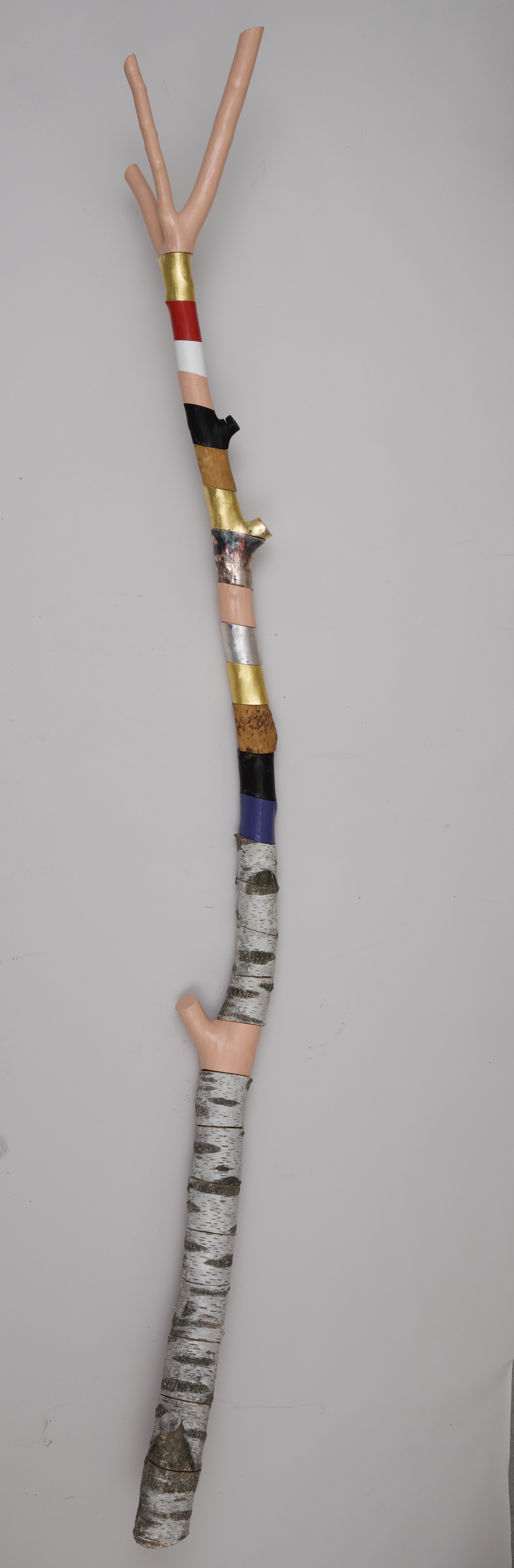
Bezemer’s staffs probe the porosity of institutional possibility, or for that matter the structural lack thereof. And while it is true that Bezemer might easily gain access to art events because he is a white man clad in a suit and does not look out of place at exhibition vernissages, he does smuggle an alien object in what is a carefully choreographed setting; a setting that has strictly defined which objects of art are on display for the viewer’s gaze and which ones are not. Often working with smaller staffs that can be concealed and pass security, Bezemer becomes more conduit than artist. By bringing artworks from his studio to exhibitions in which he is not officially participating, he disrupts – however momentarily – the focus of attention and the order of things. The staffs, and Bezemer alike, cross visible and invisible institutional thresholds, hacking the system, if you will. And yet, this infiltration is subtle and short-lived; performing more an act that measures how susceptible the context is to stretching its own parameters than radically and loudly tearing through it.
The reference to the branch
In fact, the staffs are in and by themselves transplants: branches, selectively pruned from a tree, then cut up and meticulously reconstituted into an artefact that still represents its woody source. The reference to the branch, the tree, the living organism, remains strongly present. The staffs travel to environments of artifice foreign to their “treeness”: the studio, the museum, the art gallery. To an extent one can always argue that if an object is placed in an art context, that very object will be transformed into a work of art. In other words, lean a stick against a wall in a museum and it will be seen as part of the institution’s collection. However, the same argument can be made to suggest the exact opposite: it is actually the object transforming its surroundings.
In transit and in transition
It seems to me that Frank Bezemer plays with these confusions of perception, following the staff – a hypermobile object – to wherever it will take him. As such the staffs are perpetually in transit and in transition, and the perfect measures for a time marked by unruly questions of what art is, should do, and can or could be.
Dr Nat Muller is an independent curator and writer. Her main interests include: the intersections of aesthetics, media and politics; food and contemporary art in and from the Middle East.