A Measure of Mobility

By Nat Muller

It’s probably one of the most contested debates of our time: movement and mobility. Who has the privilege, right documents, ethnicity, gender or background to traverse geographical and other boundaries, and who doesn’t. In a way the “art world”, the latter already a denomination of territory, operates as a microcosm of global politics.

An unlikely candidate

Those of us working in the art field like to think of it as progressive and critical, and therefor often fail to see how its institutions too are very much defined according to class, colour, professional status and conduct, facilitating those who can easily pass the proverbial walls of the white cube and curbing those who will remain outsiders and not exactly belong. It perhaps makes Frank Bezemer, a white middle-aged man, an unlikely candidate and yet I would argue that in many ways he occupies a grey zone of belonging and un-belonging.

                           München (DE), november 2011 Frank Bezemer & staff # 4 Photo: Walter van der Cruijsen

A white man clad in a suit

Bezemer’s staffs probe the porosity of institutional possibility, or for that matter the structural lack thereof. And while it is true that Bezemer might easily gain access to art events because he is a white man clad in a suit and does not look out of place at exhibition vernissages, he does smuggle an alien object in what is a carefully choreographed setting; a setting that has strictly defined which objects of art are on display for the viewer’s gaze and which ones are not. Often working with smaller staffs that can be concealed and pass security, Bezemer becomes more conduit than artist. By bringing artworks from his studio to exhibitions in which he is not officially participating, he disrupts – however momentarily  – the focus of attention and the order of things. The staffs, and Bezemer alike, cross visible and invisible institutional thresholds, hacking the system, if you will. And yet, this infiltration is subtle and short-lived; performing more an act that measures how susceptible the context is to stretching its own parameters than radically and loudly tearing through it.

The reference to the branch

In fact, the staffs are in and by themselves transplants: branches, selectively pruned from a tree, then cut up and meticulously reconstituted into an artefact that still represents its woody source. The reference to the branch, the tree, the living organism, remains strongly present. The staffs travel to environments of artifice foreign to their “treeness”: the studio, the museum, the art gallery. To an extent one can always argue that if an object is placed in an art context, that very object will be transformed into a work of art. In other words, lean a stick against a wall in a museum and it will be seen as part of the institution’s collection. However, the same argument can be made to suggest the exact opposite: it is actually the object transforming its surroundings.

In transit and in transition

It seems to me that Frank Bezemer plays with these confusions of perception, following the staff – a hypermobile object – to wherever it will take him. As such the staffs are perpetually in transit and in transition, and the perfect measures for a time marked by unruly questions of what art is, should do, and can or could be.


Dr Nat Muller is an independent curator and writer. Her main interests include: the intersections of aesthetics, media and politics; food and contemporary art in and from the Middle East.  

#105


Paris (FR) Palais de Tokyo, Octobre 16 2024, (With Guillaume Désanges, président du palais de Tokyo)

Twenty-eight blocks stacked into a “staff,” which gives the work the suggestion of a utensil, refer to diversity, connection and perception.  The complexities of independent observation, the beauty and necessity of all kinds of diversity,  the joy of connecting with the cosmos, nature and fellow humans!

Diversity is my starting point in 2011. The work ‘barre ronde de bois’ by Andre Cadere gave me the idea of stacking colored blocks into a staff. 

I appear in public with a staff to both present my work and commemorate André Cadere (1934-1978). He would have turned ninety this year.  His performances breathe a pleasant autonomy and are a response to his diagnosis of exclusionism in the art market.

The 28 blocks are not glued together but temporarily connected to a staff.

Each staff has a difficult-to-unravel organization and is more or less related to the surveyor’s red and white pole. The surveyor who maps earth’s surface without judgment: The art of seeing in pure form!   

A lot has remained the same since I made my first staff in 2011. First of all: the ecstasy of making; the sawing and assembling, the sanding, painting and overpainting the elements  until a chord emerges. 

While at first I was proud of not getting the wood from a construction store but cutting it myself in the forest, now I am happy because beavers throw long pieces of tree into the river for delivery to my studio.  


#103


March 23 2024, Otterlo (NL), Kröller-Müller Museum, With Hans Eijkelboom, the artist and staf #103  

André Cadere  

Every artist stands on the shoulders of many predecessors.   Through their artworks, I came to see the world better. In this almost endless line, there is one artist who is easily recognizable in my work. 

André Cadere was active between 1970 and his death in 1978. At that time you could have come across him at an opening with his mobile sculpture, his “barre ronde de bois”.   Andre Cadere wanted to draw attention to the exclusivity of the art world by infiltrating these institutions with his own art.
Initially, I only wanted to ‘steal’ the form of his sculptures. It soon became apparent that it was also necessary to continue his work by breaking into institutions, just like Andre Cadere did. Because institutions are perhaps even more hermetic now than they were in the seventies.
 
The mobile sculpture in my hand I call staff. The wood of this staff (#103) was felled by beavers and delivered to my studio by the Rhine River.  Staff #103 is in a private collection. 

André Cadere would have turned 90 this year. 


Carry Hate


Carry Hate (Staff # 71)  125cm. < # 70  #>74


I.M. Enrico Castellani

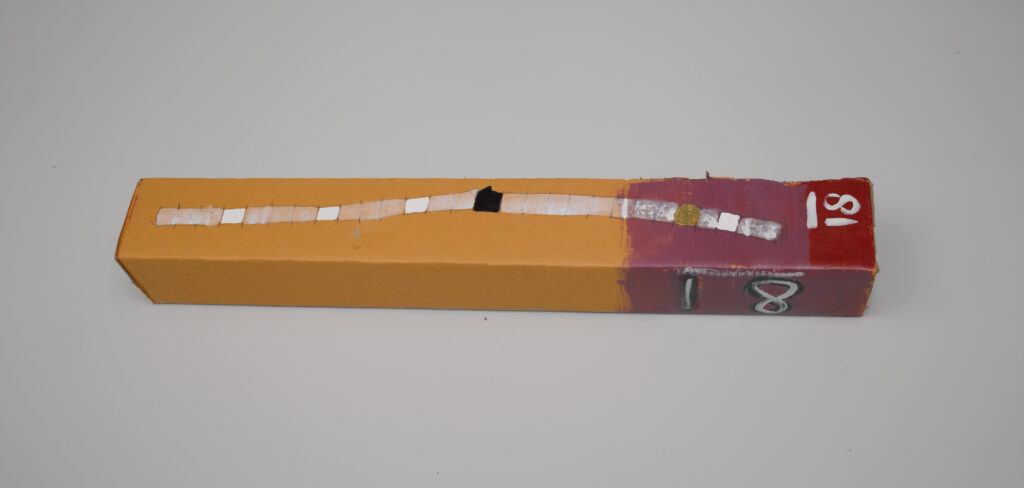
 The picture shows a box decorated with a staff.  It is the container of the staff entitled: I.M. Enrico Castellani (and numbered #81).  

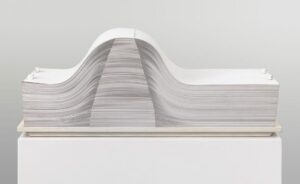
     The painted container and the sculpture  are my tributes to Enrico Castellani’s works of art; his formalist poems in silver and white. Most of all I like his paper stack. Spartito, 1969/2004.  
(Read more of Enrico Castellani in The Guardian)


It is also a tribute to Celleno where he lived until his death in December 2017. Celleno where I like to work in wintertime.  Celleno reminds me of the village I grew up in. All people connected. Connectivity and reunion are my subjects in my art practice. 

     In the village I grew up in, there lived a painter at the time. His studio was located between kindergarten and home.  At a friend’s house during primary school, I saw one of his gloomy but yet intriguing paintings of a swamp. Before I left the village to go to high-school, I tried to get up the nerve to interview him in his studio. 
He answered my questions while he was working on a painting. At one point he pushed his brush in purple paint – I was afraid he was distracted or irritated because of my questions and would soon spoil the painting with this ugly purple. The opposite happened, the painting gained more meaning instead! It was an eye-opening event!   
     In Celleno I hoped for an equally inspiring meeting, but in fact I was a  month too late; when I arrived in January 2018 Enrico Castellani had just passed away, aged 87.  
 .
.
 
 Some months later I made these ‘poems’ in black, white and gold dedicated to the artist Enrico Castellani and his direct environment.   
.
.
.


Staff # 81 I.M. Enrico Castellani

Lotta Continua 

Staff # 53.     92cm/ 36 ‘

< # 52. >  # 54


Fai del bene e sii felice

.

.

.

.

Maria Salvatori con il bastone n. 24, nel suo giardino assieme ai suoi polli.  

.

.

.

.

.

.

Staff # 24.  139 cm  54 inch

Also known as: For Raymond Hains I

< # 23   >  # 25

Passages 2024

Welkom op mijn studio op zaterdag 13 en zondag 14 april 2024 

.

.

.

.

.

.

……

Speciaal voor buurtbewoners is er de tentoonstelling  P a s s a g e s georganiseerd met werk van mijn collega’s en mij.  

 U kunt op zaterdag 13 en zondag 14 april 2024  tussen 11.00u en 17.00u komen kijken naar de binnenkant van het gebouw en de kunstwerken die er gemaakt zijn.  En desgewenst in gesprek gaan met de kunstenaar. 
(meer informatie over de foto getiteld: Study! onderaan in cursief.) 
Entree € 5,-   Dobbelmannweg 5 6531KT Nijmegen.  
 
Especially for local residents the exhibition P a s s a g e s has been organised with works by my colleagues and me.      You can come on Saturday 13 and Sunday 14 April 2024 between 11am and 5pm to see the inside of the building and the artworks created there.  And engage in conversation with the artist if you wish. 
 
Entrance fee € 5 ,-
**
About the photo titled Study! read more below

****

The photo shows the door to my studio.  From the left to the right: Two toddlers in memory of the former kindergarten, Emeritus Professor of Educational Studies at Radboud University Theo Bergen reenacting the statue on the frontside of the studio-building,  and a delicate balancing staff # 31.

The building in which my studio is located has a statue of Johanna de Lestonnac on the front facade. She has a book in her hands, to emphasize the importance of education. Johanna de Lestonnac was a woman who began educating girls in Bordeaux in the 16th century.

The building was part of a large Roman Catholic complex, with a church, a rectory, a cemetery, a convent and a variety of schools.
The building was originally built as a boarding school for girls. Then in 1931 it was transformed into a kindergarten. And in 1989, the building was converted into studios for artists.


 Staff # 31

# 74


# 74.  143cm < # 71. > # 78

Find Contents in Future and Past, find Paradise in Between II


Staff # 70   177cm/ 69′.   (Related to # 46 )    < # 69   > # 71