
.
.
.
.
.
.
Staff # 4 266cm

VIDEO-STILL CLICK ON THE IMAGE TO SEE VIDEO ON YOU-TUBE
The work of Frank Bezemer (Helmond, 1956) is centered around the power of colour, the beauty of diversity and the strength of union and connectivity. He explored these premises by painting colour fields and arranging pieces of construction wood into new compositions. Since 2011, Bezemer has been making ‘staffs’, recognizable sculptures constructed from parts in ten different colours. With these works. He explores the effect and interaction of colours. The artist deconstructs an existing branch into cylindrical shapes of equal size. He then paints these parts, before putting them back together. The traditional travelers’ tool, the staff, is reinvented in this way. The staffs refer to the walking stick, but also to the magic wand, the antenna, the scepter, and the pole. The works seem to have the potential to guide us and give us advice. Below the exterior of the (bright) colours and surprising colour combination, one can sense the natural strength of the staffs. The artist is fascinated by the notion that new shoots can suddenly develop from a stick or piece of wood. The staffs embody this potential of new life.
However different the seventy or more bars may be that Frank Bezemer has created in recent years, they are all captured, or perhaps better said: encapsulated, within a single system. A system that is deeply rooted in Frank’s conviction that ‘diversity is beautiful.’ And the same interpretation may certainly be applied within a societal context.
As a starting point for diversity, Frank chooses the colours for which one word exists in the Dutch language: blue, brown, yellow, grey, green, orange, purple white and black. Rose (the Dutch word for pink) is excluded because it sounds too French.
For the artist, the next matter is to decide how these colours should be combined; and thus it becomes a question of form. It is André Cadere who, with his “Round Bar of Wood”, inspires Frank. Not only by using the bar as his form, but also by his systematic approach to arranging its components.
Each bar is divided into 28 segments, with the height of each segment always equal to the diameter. The length of the bar depends on the thickness of the branch from which the bar is made. The 28 parts are the result of the system in which the colours are arranged on the bar. The centre of the bar contains the ten colours whose names are arranged alphabetically. First four, and then two of these ten colours are mirrored on both sides and interrupted in fixed places by the colour at the front or back of the series of ten colours. Within this approach, Frank permits one error in each bar to break the dictatorship of the system.
Naturally, the art academy impressed upon Frank that an artist should be original, but the direction that Cadere points to regarding this question is too convincing to ignore: the bar as a vertical painting, in which Frank can add his colours as a cohesive whole, thus expressing the beauty of diversity.
There is still another step to go. From personal preference to organized coincidence, from an arbitrary to a systematic approach, because diversity only gains colour in cohesion. Beyond this, indifference rules. Which is why Frank has designed a system that defines how the colours should be arranged on the bar. The system gives Frank a guideline for working freely, without having to think about choosing between green or red, blue or brown.
Once the basic colours, the shape, and the system have been determined, Frank can concentrate purely on the colour nuances. Also, by literally changing language, he is able to alter the sequence of the colours, thereby giving each bar a different identity, just as each language also expresses its own individuality.
Frank glues the segments of the first bar together. This also makes the final result a gamble, however, as once affixed, the bar is a given. Since Frank also wants to view the bars as an artist, and although it is not the order but the colours that he wants to be able to nuance as such, the bars become dismantlable, so that corrections are still possible; the parts are connected using dowels and wire ends.
Although the system initially serves as his guideline, in time Frank comes up against the limitations of the choices he has made. He thus becomes fascinated in the streetscape by the never-before-seen colour combinations in the Somali women’s clothing. But he is unable to translate this within his system, which he developed for the precise purpose of expressing his starting principle ‘diversity is beautiful’. One initial way around this is to make the leap to English, which has its own descriptor for the Dutch word rose: pink. He also replaces yellow with gold. This enables him to enrich and deepen the colour palette available to him.


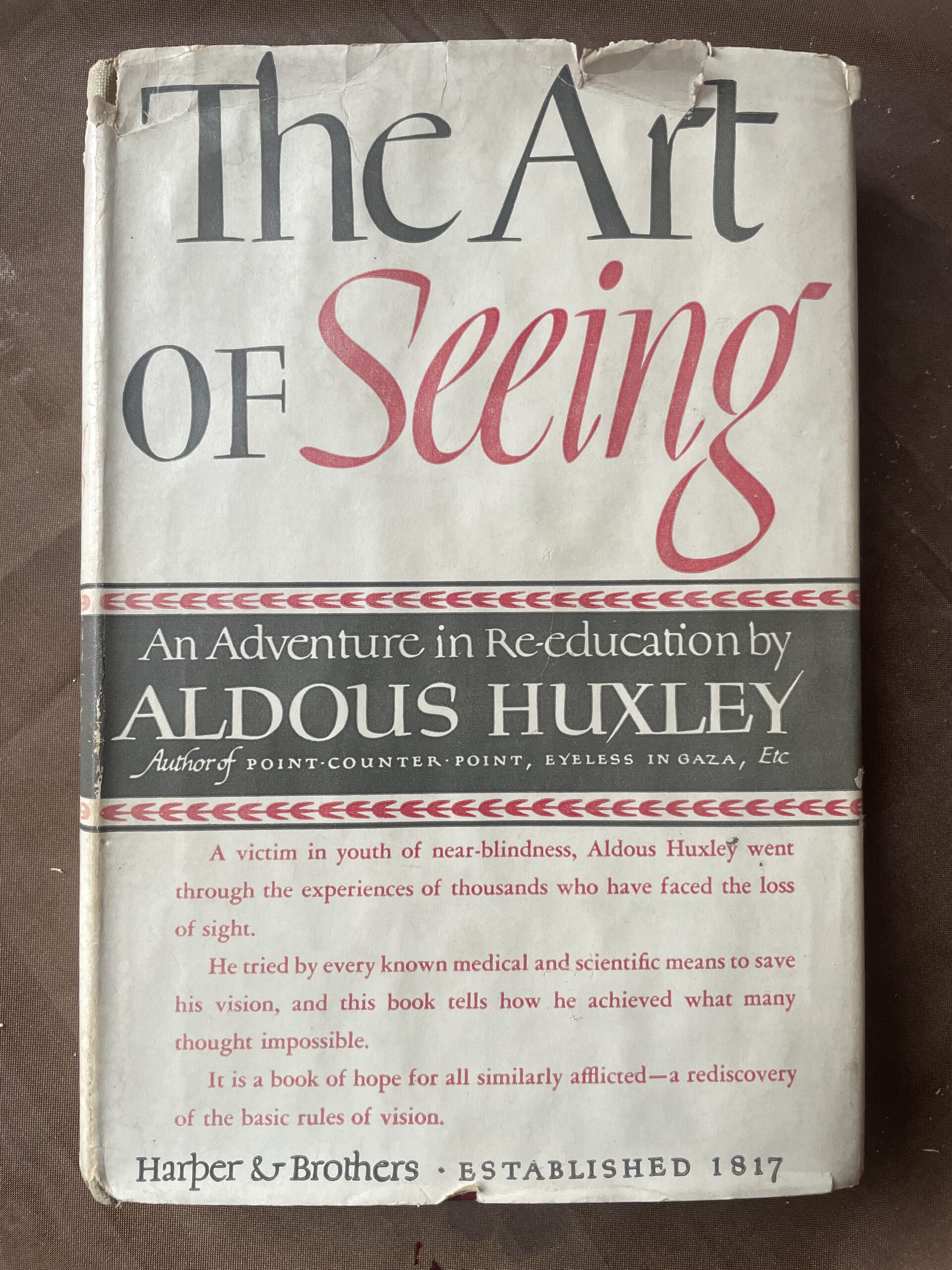
The Art of Seeing
The scent of freshly baked bread, music that moves you, a loving caress, the serene beauty of a painting; the basis of my life and work are sensory experiences. And I use colour to pass on these sensations. The precise colours, I find in an instinctive, intuitive and meditative way.
A way which is limited on all sides. And which also requires some preparation: It starts with the choice of the branch. The shape and size of the branch is often inspired by a tool. Do I want a staff, a cudgel, a sceptre, a yardstick, a dipstick, an antenna, a ranging pole or something else entirely?
The ranging rod is the tool of the surveyor. On the photo, taken a hundred years ago in Idaho, the ranging rods still looked slightly more complicated. Now, it is the familiar red-and-white pole one pricks into the ground. Incidentally, the surveyor is a special observer, because he looks without judgement and sees without wish: he sees what is there, accepts everything and rejects nothing. That is why I connect the ranging rod with independent perception, with the true art of seeing, without influences or limitations. And look what pleasure that brings to this female survey crew!
The title for the series, I borrowed from a book I read forty-five years ago, which, back then, was already old-fashioned and tough. The title: The Art of Seeing, remains a current issue. Current, because perception in the age of digital memory functions differently.
In fact, it seems that the behaviour you are tempted into in the 21st century, automatically makes you visually impaired. The book made a big impression on me at the time. It might not be all that useful to people with genetically determined myopia. But for me it was true that with three instructions from this book, I could correct my own behaviour at an early stage. It has greatly improved my own perception, literally opening up a world to me.
Frank Bezemer 2018
PERCEIVE!
1) Relax! Do not overload your eyes. Blink regularly, always allowing your eyes a moment of rest. If you are in total darkness and you see purple, yellow or other coloured spots, this is a sign of serious fatigue. Rest your eyes until the spots are gone.
2) Move! Just as staring is the way to make the image slowly but surely fade, so moving (the eye) keeps everything sharp. So park your laptop in front of a window with a (preferably panoramic) view and consciously enjoy this regularly: follow a person, animal or object present in that view. If you are in a train, you can try to focus your attention on a point on the horizon. If you are reading a book, you can try to follow the lines of one letter. The finer you can make the movements of your eyes, the sharper the perception.
3) Improve your memory! Memory is the basis of all seeing. The eye is no more than a transmitting channel. For example, by comparing old observations with recent ones, we do not see a green spot but a tree, or not a tree but an oak. An example of a memory exercise is: First close your eyes and then open them only for a split second. Now describe what you have seen, check what you may have forgotten and realise how much you can see in a split second. Keep making the exercise more difficult.
FRAMEWORK
The carrier is a birch branch. In the backyard of the studio I find the right branch or tree.
The separation of the colours is not suggestive but real. This means that every colour has to be applied to a separated piece. The thickness of the trunk determines the length of the piece to be sawn off.
A maximum of ten different colours per work. The choice of ten colours stems from the number of words that exist for colours in my Dutch mother tongue (black and white included).
Each work consists of a 28-part structure. The ten different colours are situated in the middle. Nine of the ten colours repeat themselves through mirroring, and subsequently, a flaw is added. Together they add up to 28 parts.
The order of the ten colours is determined according to a self-constructed system of chance. The words for the ten colours in the middle are arranged alphabetically. The 28-part structure then determines the colour of the other 18 elements.
HET GELUK