A Measure of Mobility

It’s probably one of the most contested debates of our time: movement and mobility. Who has the privilege, right documents, ethnicity, gender or background to traverse geographical and other boundaries, and who doesn’t. In a way the “art world”, the latter already a denomination of territory, operates as a microcosm of global politics. Those of us working in the art field like to think of it as progressive and critical, and therefor often fail to see how its institutions too are very much defined according to class, colour, professional status and conduct, facilitating those who can easily pass the proverbial walls of the white cube and curbing those who will remain outsiders and not exactly belong. It perhaps makes Frank Bezemer, a white middle-aged man, an unlikely candidate and yet I would argue that in many ways he occupies a grey zone of belonging and un-belonging.

                           München november 2011 Frank Bezemer & staff # 4 Photo: Walter van der Cruijsen

Bezemer’s staffs probe the porosity of institutional possibility, or for that matter the structural lack thereof. And while it is true that Bezemer might easily gain access to art events because he is a white man clad in a suit and does not look out of place at exhibition vernissages, he does smuggle an alien object in what is a carefully choreographed setting; a setting that has strictly defined which objects of art are on display for the viewer’s gaze and which ones are not. Often working with smaller staffs that can be concealed and pass security, Bezemer becomes more conduit than artist. By bringing artworks from his studio to exhibitions in which he is not officially participating, he disrupts – however momentarily  – the focus of attention and the order of things. The staffs, and Bezemer alike, cross visible and invisible institutional thresholds, hacking the system, if you will. And yet, this infiltration is subtle and short-lived; performing more an act that measures how susceptible the context is to stretching its own parameters than radically and loudly tearing through it.

In fact, the staffs are in and by themselves transplants: branches, selectively pruned from a tree, then cut up and meticulously reconstituted into an artefact that still represents its woody source. The reference to the branch, the tree, the living organism, remains strongly present. The staffs travel to environments of artifice foreign to their “treeness”: the studio, the museum, the art gallery. To an extent one can always argue that if an object is placed in an art context, that very object will be transformed into a work of art. In other words, lean a stick against a wall in a museum and it will be seen as part of the institution’s collection. However, the same argument can be made to suggest the exact opposite: it is actually the object transforming its surroundings.

It seems to me that Frank Bezemer plays with these confusions of perception, following the staff – a hypermobile object – to wherever it will take him. As such the staffs are perpetually in transit and in transition, and the perfect measures for a time marked by unruly questions of what art is, should do, and can or could be.

Dr Nat Muller is an independent curator and writer. Her main interests include: the intersections of aesthetics, media and politics; food and contemporary art in and from the Middle East.  
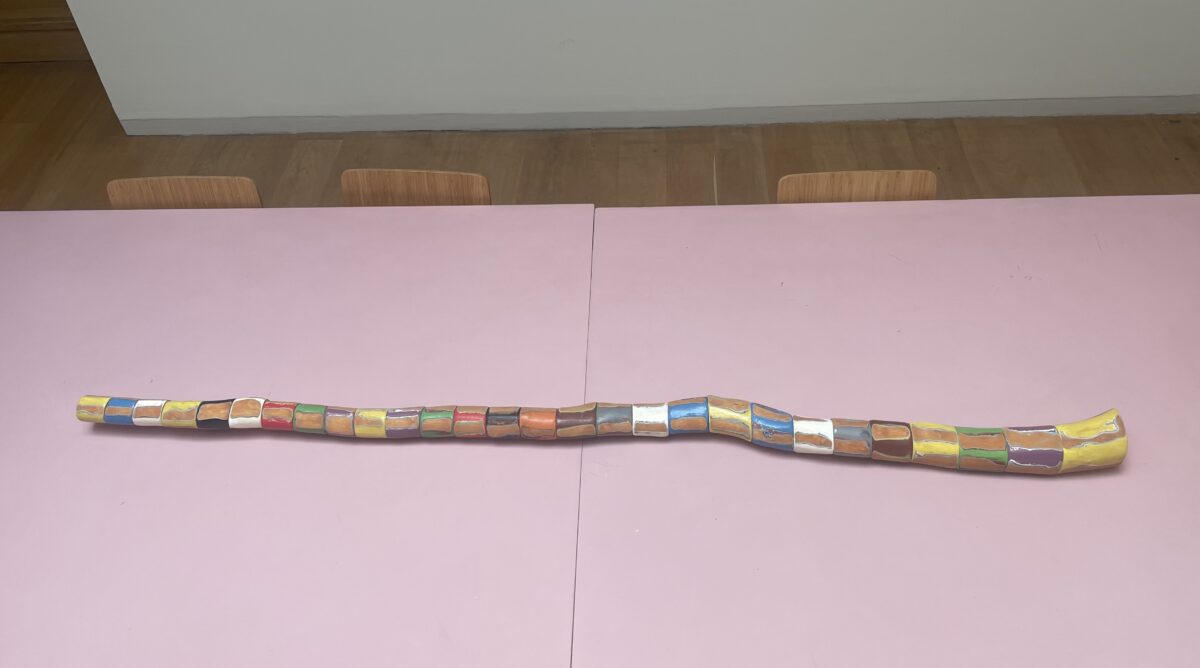
Hope (staff #104)

 
April 30 2025
With the work Hope (staff #104, 286cm) I want to express my desire for a biodiverse environment, for a future full of poetry.  No more monoculture anywhere not even in this courtyard of Galway University’s administration building.
…………………………………………………………………………………………………………………….
…………………………………………………………………………………………………….

The Statue of Connectivity Amsterdam


I invited passersby to join me in creating The (Living) Statue of Connectivity. Together, using this staff and the presence of others, I expressed my wish for a colorful and connected society. People aged 17 to 96 stepped onto the pedestal. A week and a half later, I received this message from North Carolina:

Hey Frank, My brothers and I were on holiday last week visiting Amsterdam where we crossed paths and took a photo with you. Your concept was so unique and different to us that we keep talking about it afterwards. I then thought, let me look up statue of connectivity Amsterdam and to my surprise your website showed up. Thank you for being kind and passing on the message of connectivity and diversity. Best, Jairo (brown jacket) 

The Statue of Connectivity


This Wednesday, January 15, 2025 between 1:30 and 2:30 p.m. you can experience The Statue of Connectivity on Dam Square in Amsterdam. The colorful cubes are then assembled into staff #93. With this staff and with other people I express my wish for a colorful and connected society.

#105


Twenty-eight blocks stacked into a “staff,” which gives the work the suggestion of a utensil, refer to diversity, connection and perception.  The complexities of independent observation, the beauty and necessity of all kinds of diversity,  the joy of connecting with the cosmos, nature and fellow humans!

Photo:  With Guillaume Désanges, président du palais de Tokyo, October 16, 2024

Diversity is my starting point in 2011. The work ‘barre ronde de bois’ by Andre Cadere gave me the idea of stacking colored blocks into a staff. 

I appear in public with a staff to both present my work and commemorate André Cadere (1934-1978). He would have turned ninety this year.  His performances breathe a pleasant autonomy and are a response to his diagnosis of exclusionism in the art market.

The 28 blocks are not glued together but temporarily connected to a staff.

Each staff has a difficult-to-unravel organization and is more or less related to the surveyor’s red and white pole. The surveyor who maps earth’s surface without judgment: The art of seeing in pure form!   

A lot has remained the same since I made my first staff in 2011. First of all: the ecstasy of making; the sawing and assembling, the sanding, painting and overpainting the elements  until a chord emerges. 

While at first I was proud of not getting the wood from a construction store but cutting it myself in the forest, now I am happy because beavers throw long pieces of tree into the river for delivery to my studio.  


#103


Every artist stands on the shoulders of many predecessors.   Through their artworks, I came to see the world better. In this almost endless line, there is one artist who is easily recognizable in my work. 

André Cadere was active between 1970 and his death in 1978. At that time you could have come across him at an opening with his mobile sculpture, his “barre ronde de bois”.   
The photo shows me with Hans Eijkelboom during an opening (March 23 2024) at the Kröller-Müller Museum.  

The mobile sculpture in my hand I call staff. The wood of this staff (#103) was felled by beavers and delivered to my studio by rivers. Staff #103 is in a private collection. 

André Cadere would have turned 90 this year. 


# 52 Christiana’s Sceptre


For Christiana, photo 18 x 25 cm. 7 x 10,6 inch


In 2014, I read an interview with Christiana Figueres, the president of the upcoming 2015 Paris Climate Conference. She spoke about the enormous responsibility she carried, despite having almost no real power. To help symbolically bridge that gap, I spontaneously decided to visit the UN office and offer her (or her assistant) a scepter. However, I was stopped by UN security and couldn’t deliver it. It was fascinating, though, to see the scepter on the X-ray scanner. Six years later, I met a woman who truly had both power and responsibility — and I took this photo.


# 52 Christiana’s Sceptre, 2014, 43,7 inch  125cm


X-ray by UN-security.

Endless Diversity

The sculpture Endless Diversity (staff #101)  calls for breaking the pattern of monoculture.

(Over forty percent of the surface area in the Netherlands is used for monoculture. Twenty percent of the Netherlands is full of the monocultures for the purpose of cattle feed; grass and corn.)


Staf #101

Staff 87

.

.

.

.

.

.


During an extended stay in Georgia in 2018, I experienced the valiant fight against voter suppression led by Stacey Abrams. Back in the Netherlands, I dedicate a staff to her.